
Barcelona, 3 July 2026
Barcelona Liver Bioservices (BLB) is pleased to announce the publication of a new study describing the development and application of a microfluidic human precision-cut liver slice platform for the long-term ex vivo modelling of advanced chronic liver disease (ACLD) and the evaluation of antifibrotic therapeutic strategies.
Advanced chronic liver disease is characterized by progressive extracellular matrix remodelling, hepatic stellate cell activation, and fibrotic collagen deposition. However, the lack of human-based experimental models that preserve cirrhotic liver tissue for extended periods has limited the study of disease mechanisms and the preclinical evaluation of antifibrotic therapies.
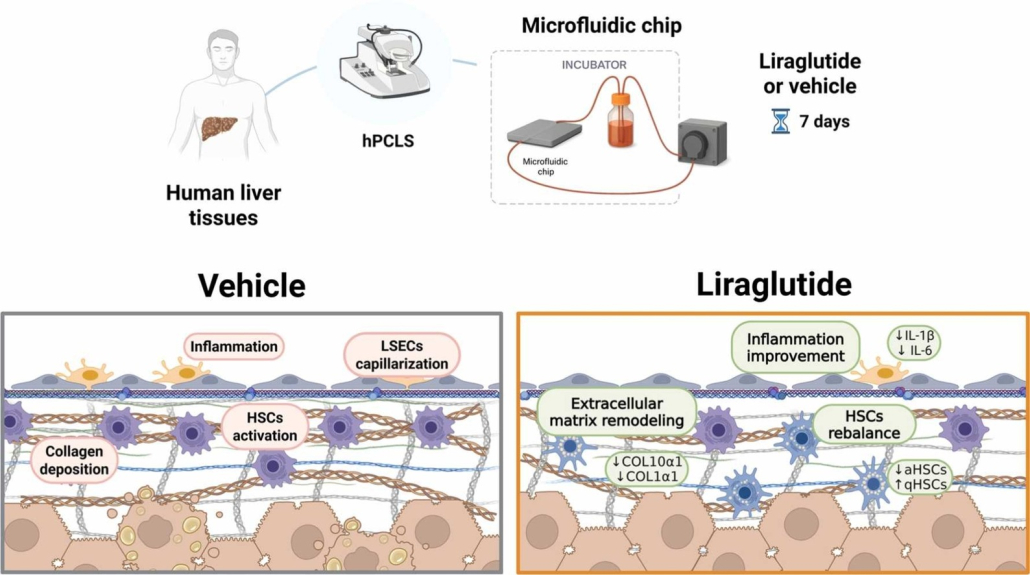
In this work, the research team established a microfluidic culture system that enables the preservation of human cirrhotic precision-cut liver slices for up to 7 days. Compared with conventional static culture, the microfluidic platform improved tissue integrity, reduced necrosis and fibrosis, and supported sinusoidal cell communication, offering a more physiologically relevant environment to study human ACLD ex vivo.
Using this platform, the study evaluated the effects of liraglutide in human cirrhotic liver tissue. The results showed that liraglutide exerts direct antifibrotic effects through hepatic stellate cell deactivation, extracellular matrix remodelling, reduced fibrotic collagen deposition, metabolic reprogramming, and inhibition of AKT signalling. Importantly, these effects appeared to be independent of canonical GLP1R signalling, opening new perspectives on how GLP-1 receptor agonists may modulate fibrotic liver tissue.
The study also identified COL10α1 as a potential biomarker of fibrosis progression and regression in human ACLD tissue, with possible utility for evaluating antifibrotic therapeutic responses.
With this publication, BLB incorporates microfluidic human cirrhotic PCLS technology into its portfolio of translational liver research services, making it available to current and future partners interested in human-based disease modelling, antifibrotic drug testing, and therapeutic development.
This new platform complements BLB’s integrated portfolio, which includes cell-based studies, preclinical animal models, human liver tissue platforms, microfluidic PCLS, and advanced bioinformatic analyses. Together, these capabilities allow BLB to support partners from mechanistic discovery to human-based validation and actionable preclinical insights.
At BLB, we are committed to advancing clinically relevant experimental models that bridge the gap between conventional preclinical systems and human disease. The incorporation of microfluidic human cirrhotic liver slices reinforces our mission to accelerate innovation in chronic liver disease research and drug development.
Full article: https://www.sciencedirect.com/science/article/pii/S075333222600747X